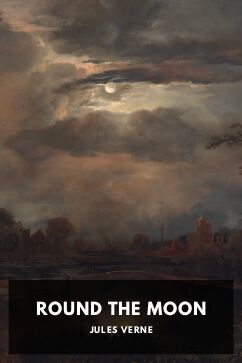
Round the Moon - Jules Verne
If you read 'From the Earth to the Moon,' you remember the cliffhanger: the giant space bullet has been fired. 'Round the Moon' is the thrilling continuation of that journey. We join the three passengers—the practical American inventor Barbicane, his rival-turned-companion Captain Nicholl, and the enthusiastic French adventurer Michel Ardan—as they experience space travel for the first time.
The Story
The book is their travel log. We feel their wonder as weightlessness sets in and they float around their cabin. We see their awe as Earth becomes a distant disc and the moon grows larger. But it's not a smooth ride. A run-in with a rogue meteoroid throws them off course, a problem they have to solve using only the physics and tools they have on board. The central tension becomes a desperate fight against their own trajectory. Will they be pulled into the moon's gravity and crash? Will they whip around it and be slung back toward Earth? Or will they miss everything and become a permanent tomb drifting in the endless night? The suspense builds page by page as they calculate, argue, and hope.
Why You Should Read It
What makes this book special is Verne's incredible balance. He fills pages with real (for the 1860s) astronomical facts and physics problems, but he never lets the science drown the people. Michel Ardan's humor and poetic perspective constantly lighten the mood, while Barbicane and Nicholl represent cool, logical determination. Their dynamic feels genuine. You're right there with them, feeling the isolation of space and the tension of their predicament. It's amazing to see how many things Verne got eerily right about space travel—like weightlessness and the use of rockets for course correction—purely through imagination and research.
Final Verdict
This is a classic for a reason. It's perfect for anyone who loves a good adventure story with smart characters solving big problems. If you enjoy the technical details in stories like 'The Martian,' you'll appreciate Verne's puzzle-solving. If you just want to feel the thrill of early science fiction and a journey into the complete unknown, this book delivers. It’s a foundational piece of sci-fi that’s still surprisingly exciting and accessible today. Just be ready to start with 'From the Earth to the Moon' first—you'll want the full launch experience.
There are no legal restrictions on this material. Thank you for supporting open literature.