
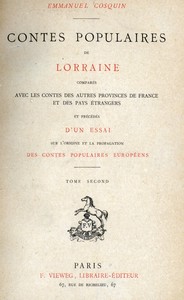
Contes populaires de Lorraine, comparés avec les contes des autres provinces de…
Okay, let's be clear: this isn't a novel. You don't pick up Emmanuel Cosquin's Contes populaires de Lorraine for a quick, relaxing fairy tale. Think of it more as the fascinating lab notes from a story scientist. Cosquin spent years in the 19th century writing down folktales from the Lorraine region of France, exactly as people told them. But he didn't stop there. For every tale—whether it's about a boy outwitting a giant or a girl escaping a witch—he goes on a global search for its twins.
The Story
The 'plot' is the journey of the stories themselves. The book presents a Lorraine folktale, then Cosquin acts as your guide, showing you its nearly identical sibling from, say, Norway, and then its distant cousin from Japan. He points out the swapped characters, the changed settings, and the core plot that remains stubbornly the same. It's a massive comparative study, showing how stories like 'Cinderella' or 'The Animal Bridegroom' appear in hundreds of cultures with slight variations. The narrative is the evidence piling up, page after page, revealing a hidden web of human connection through storytelling.
Why You Should Read It
This book changed how I think about stories. It’s easy to assume our local tales are unique. Cosquin proves they're part of a global family. Reading it feels like getting a secret key to understanding people. A story from a French village fireplace has the same heartbeat as one told in a Siberian yurt. That's powerful stuff. It’s not dry history; it’s a reminder of our shared imagination. You start seeing the blueprints behind all the stories you love, from Disney movies to fantasy novels, and it makes them all feel richer.
Final Verdict
This is a specialized book, but don't let that scare you off. It's perfect for the naturally curious reader—the person who loves mythology, folklore, or the history of ideas. If you've ever fallen down a Wikipedia rabbit hole comparing different versions of a myth, this is your ultimate source text. It's also a goldmine for writers looking for ancient, proven story patterns. Fair warning: it's dense and academic in places. But dip into a chapter here and there, follow one tale's journey around the world, and you'll be hooked. It’s a book that doesn't just tell stories; it solves the oldest mystery of them all: why we all need to tell them.
The copyright for this book has expired, making it public property. It serves as a testament to our shared literary heritage.
Aiden Brown
1 year agoAmazing book.
Patricia Jones
11 months agoSurprisingly enough, the narrative structure is incredibly compelling. A true masterpiece.
Emily Wilson
8 months agoI have to admit, the flow of the text seems very fluid. A true masterpiece.