
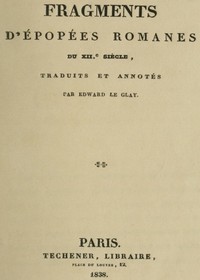
Fragments d'épopées romanes du XIIe siècle by Edward Le Glay
Let's be clear from the start: this isn't a novel. Fragments d'épopées romanes du XIIe siècle is exactly what the title says—a collection of fragments. Edward Le Glay didn't write these stories; he found them, studied them, and presented them to us. The book gathers surviving pieces of long, narrative poems (called chansons de geste and romances) from medieval France. Think of it as a puzzle where most of the pieces are lost forever.
The Story
There is no single plot. Instead, you jump from one fragment to another. One moment you're in the thick of a brutal siege, with swords clashing and war cries echoing. The next, you're in a quiet court where a knight is swearing a solemn oath to his king or pining for a distant love. You might meet a fierce Saracen warrior, a cunning sorcerer, or a loyal horse that seems to understand human speech. Because they're fragments, these scenes often cut off abruptly. A hero charges into battle... and the text ends. A secret is about to be revealed... and the parchment is torn. It's frustrating in the best possible way, because your imagination has to do the heavy lifting to bridge the gaps.
Why You Should Read It
This book is a mood. It’s not about following a character from start to finish; it’s about soaking up the atmosphere of the 12th century. The raw emotion in these pieces is stunning. You feel the exhaustion after a battle, the sting of betrayal, the flash of honor in a knight's deed. Reading these fragments makes history feel immediate and human, not just a list of dates. Le Glay's work is crucial because he provides context, explaining where each fragment was found and what the complete story might have been about. He’s not just showing us broken pottery; he’s helping us picture the original vase.
Final Verdict
This is a niche but wonderful read. It's perfect for history buffs, medieval literature fans, or anyone who loves a good mystery. If you need a tight, fast-paced plot, look elsewhere. But if you enjoy poetic language, epic themes, and the thrill of literary archaeology, you'll find this fascinating. It's like visiting a museum for stories, where each exhibit is a beautiful, incomplete relic that hints at a world much grander than itself. You come away not with a story, but with the ghost of many stories—and that’s a powerful feeling.
This historical work is free of copyright protections. You do not need permission to reproduce this work.
Elizabeth Miller
3 months agoI stumbled upon this title and the character development leaves a lasting impact. I will read more from this author.
Oliver Lopez
1 year agoSurprisingly enough, the emotional weight of the story is balanced perfectly. I couldn't put it down.