
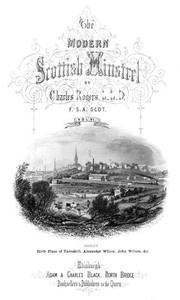
The Modern Scottish Minstrel, Volume 6. by Charles Rogers
Let's be clear from the start: this isn't your typical page-turner. 'The Modern Scottish Minstrel, Volume 6' is a time capsule. Compiled in the 1850s by editor and historian Charles Rogers, it's the sixth installment in a massive effort to gather the songs and poems of Scotland from the late 1700s onward. Think of it as a mixtape from another century, filled with ballads, love songs, patriotic anthems, and witty verses.
The Story
There's no linear plot. Instead, you open the book and meet a crowd of voices. Some are famous, like Robert Tannahill or the Ettrick Shepherd. Many are obscure—farmers, weavers, soldiers who put their experiences to verse. Rogers didn't just collect the pretty words; he hunted down biographical notes, giving us glimpses into the lives behind the lyrics. One poem might be a lament for a lost love from a Highland glen, the next a humorous take on city life from Glasgow. The 'story' is the collective hum of a nation figuring itself out through song during a period of huge change, from rural traditions to the dawn of the industrial age.
Why You Should Read It
I'll be honest, you don't read this book cover-to-cover in one sitting. You dip in and out. And that's where the magic happens. You might flip to a page and find a heartbreakingly simple song about exile that sticks with you all day. The power is in the rawness and authenticity. This isn't literature polished for London critics; it's the stuff of pub singsongs, hearthside recitals, and personal diaries. It shows how people used poetry and music as a tool for joy, protest, comfort, and memory. Rogers's brief notes on each poet are often as compelling as the verses, painting a picture of a society where everyone, from the laird to the laborer, might try their hand at a rhyme.
Final Verdict
This is a specialist's treasure but an accessible one. It's perfect for history buffs, genealogy enthusiasts, or anyone with Scottish roots looking to touch the cultural soil of their ancestors. It's also great for writers and songwriters seeking inspiration from unfiltered, pre-modern voices. If you love the idea of literary archaeology—sifting through fragments to hear echoes of the past—you'll find this fascinating. But if you need a driven narrative, this probably isn't it. Approach it like a museum visit: wander, pause at what catches your eye, and let the past speak for itself.
This digital edition is based on a public domain text. It is available for public use and education.
Patricia Nguyen
1 year agoEssential reading for students of this field.
Susan Robinson
3 months agoRecommended.
Amanda Torres
1 year agoFinally a version with clear text and no errors.
Donna Young
7 months agoI had low expectations initially, however it challenges the reader's perspective in an intellectual way. I will read more from this author.



Jackson Perez
1 year agoVery interesting perspective.