
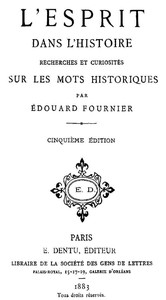
L'esprit dans l'histoire: Recherches et curiosités sur les mots historiques
Edouard Fournier's L'esprit dans l'histoire: Recherches et curiosités sur les mots historiques isn't a traditional history book with a linear plot. Think of it more as a series of fascinating investigations. The 'story' is Fournier's journey through centuries of European history, armed with a simple but powerful question: 'Did they really say that?'
The Story
Fournier acts as a literary and historical detective. He takes well-known phrases—the kind you find in motivational posters and history textbooks—and traces them back to their source. He looks at quotes attributed to kings like Louis XIV, revolutionaries, philosophers, and military leaders. Time and again, he finds that the perfect, memorable line was often invented by a playwright, misremembered by a chronicler, or attached to a famous person long after the fact to make a better story. The book is structured around these mini-mysteries, each one unpacking how a myth was born and how it stuck. It's less about grand narratives and more about correcting the record, one famous sentence at a time.
Why You Should Read It
This book completely changed how I listen to famous quotes. It's incredibly satisfying, like watching a myth get busted. Fournier has a dry, witty style that feels like listening to a very clever friend explain why something 'everyone knows' is wrong. You start to see history not as a series of scripted moments with perfect dialogue, but as a messy reality that later generations constantly tidy up and dramatize. It makes you skeptical in the best way. You'll never hear 'Let them eat cake' the same way again. More importantly, it highlights how powerful words are—even invented ones—in shaping our understanding of the past.
Final Verdict
This is a perfect book for history buffs who are tired of the same old stories and want to peek behind the curtain. It's also great for word nerds, trivia lovers, and anyone who enjoys a good 'gotcha' moment. Be warned: it was written in the 1800s and focuses mainly on French and European history, so some references might require a quick Google. But the core idea—that history is full of good stories that aren't quite true—is timeless. If you like the idea of history as a puzzle rather than a sermon, you'll find Fournier to be a brilliant and entertaining guide.
No rights are reserved for this publication. It serves as a testament to our shared literary heritage.
John Allen
1 year agoIf you enjoy this genre, the author's voice is distinct and makes complex topics easy to digest. Worth every second.
Noah Rodriguez
9 months agoI stumbled upon this title and the storytelling feels authentic and emotionally grounded. Truly inspiring.





Ethan Smith
5 months agoIf you enjoy this genre, the pacing is just right, keeping you engaged. I will read more from this author.